Digital colleagues give healthcare room to breathe
· Umar Nizamani
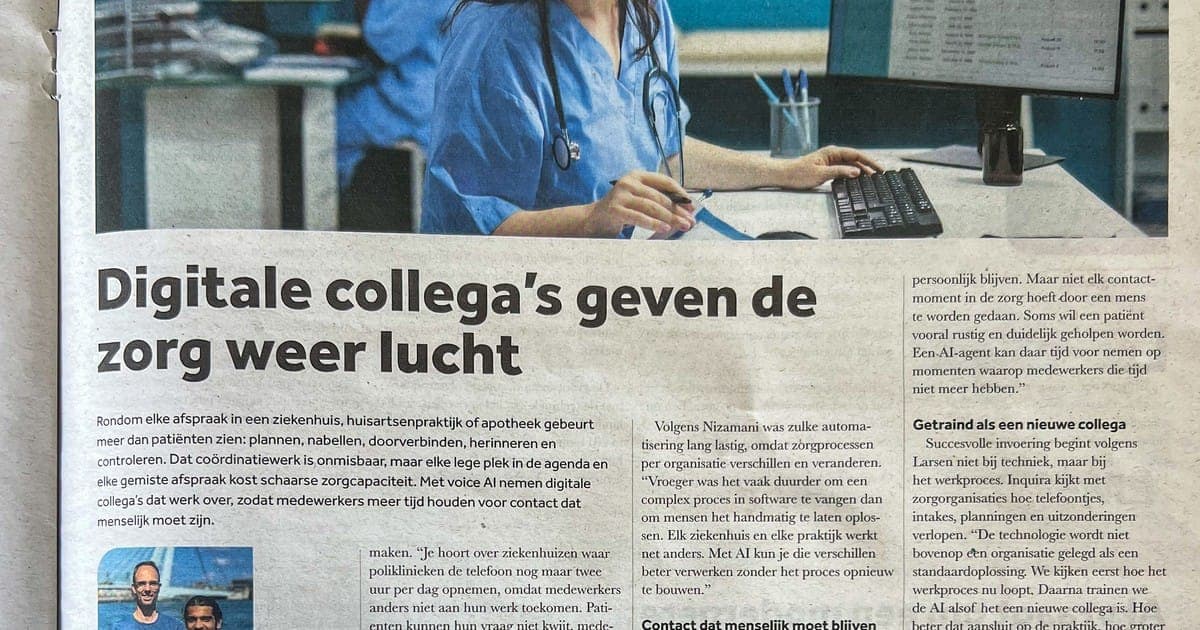
As published (in Dutch) in the special "Toekomst van de zorg" (The Future of Healthcare), distributed with Het Financieele Dagblad. Partner content by Inquira.
Around every appointment in a hospital, GP practice or pharmacy, more happens than seeing patients: scheduling, calling back, transferring, reminding and checking. That coordination work is indispensable, but every empty slot in the agenda and every missed appointment costs scarce healthcare capacity. With voice AI, digital colleagues take over that work, so staff keep more time for contact that needs to be human.
According to Umar Nizamani and Jan Peter Larsen, founders of Inquira, this administrative coordination is precisely where an underestimated bottleneck sits. The discussion about staff shortages is usually about nurses, doctors and care workers, but the supporting layer around them is under just as much pressure. "Around the primary care process sits an enormous amount of coordination. Think of appointments, phone calls, patients who don't show up and questions that keep coming back. That work is indispensable, but it also puts a lot of pressure on organisations," says Larsen. Inquira wants to relieve that with digital colleagues, powered by voice AI, that take this coordinating work off people's hands.
The logistics around the patient are still manual work
How great that pressure has become is clear from the choices organisations are forced to make. "You hear about hospitals where outpatient clinics only answer the phone two hours a day, because otherwise staff can't get to their work. Patients can't get their question answered, employees are constantly interrupted and capacity goes unused. No-show rates also sit between 5% and 10%."
Digital records have changed healthcare, but the logistics around the patient are still largely manual work. That is where Nizamani sees room for automation. "Healthcare organisations spend enormous amounts of time and money on administration. A large part of that sits in the front office and in care logistics. That is where AI can help for the first time, because the technology has become flexible enough."
Voice AI: a colleague whose line is never busy
The technology Inquira bets on is voice AI: digital colleagues that hold conversations, answer questions and carry out actions in the systems of healthcare organisations. A patient can call to ask when an appointment is, whether a result is ready, or how an appointment can be rescheduled. The AI helps where it can and transfers the call when a human is needed. The system does not give medical advice. "It is about administrative and coordinating tasks," says Larsen. "As soon as a medical judgement is needed, a professional has to take over."
According to Nizamani, this kind of automation was difficult for a long time, because care processes differ per organisation and keep changing. "It used to be more expensive to capture a complex process in software than to have people solve it manually. Every hospital and every practice works slightly differently. With AI you can handle those differences without rebuilding the process from scratch."
Contact that needs to stay human
The value sits in tasks that cost time but do not always have to be carried out by a healthcare professional. Think of reminding patients of an appointment, calling people on a waiting list when a slot opens up, checking whether an intake is complete or verifying whether someone has had their blood drawn beforehand. Scheduling and rescheduling appointments happens directly in the EHR. And when a care provider calls in sick, the digital colleague calls all affected patients in a short time, a task organisations run into every week. This way the same care capacity is used better. The front-desk employee changes from the person who calls and arranges everything themselves into someone who directs a team of digital colleagues, keeping time for the conversations where a human makes the difference.
The human side of care does not have to disappear because of this. The less professionals are burdened with repetitive questions, the more room remains for contact that truly needs to be human. Nizamani mentions older patients who appreciated the digital colleague because it calmly explained where to find a patient number. "Personal contact must remain personal. But not every contact moment in healthcare has to be handled by a human. Sometimes a patient mainly wants to be helped calmly and clearly. An AI agent can take that time at moments when staff no longer have it."
Trained like a new colleague
Successful adoption, according to Larsen, does not start with technology but with the work process. Inquira looks together with healthcare organisations at how phone calls, intakes, scheduling and exceptions actually run. "The technology is not laid on top of an organisation as a standard solution. We first look at how the work process runs today. Then we train the AI as if it were a new colleague. The better it fits actual practice, the greater the chance that staff and patients can work with it."
Safety and trust are preconditions. The technology works with sensitive patient data and has to fit the high standards of healthcare. Nizamani points to European data storage, logging, strict boundaries against medical advice and healthcare-specific standards. "This is not a fun gadget you casually drop into healthcare. From the first lines of code you have to account for safety, privacy and responsibility. Only then can you deploy AI responsibly at scale."
In the coming years the application shifts towards chains of care coordination: not only reminding someone of an appointment, but also checking whether a referral has been picked up, whether a patient arrives prepared and whether follow-up actions are needed. That makes AI not a replacement for doctors or nurses, but an organisational layer. Nizamani and Larsen expect that within a few years digital colleagues will be as self-evident as a calendar or a patient record. Not to take the human out of healthcare, but to give people back time for the work that truly matters.
Original Dutch article: Toekomst van de zorg, p. 11